

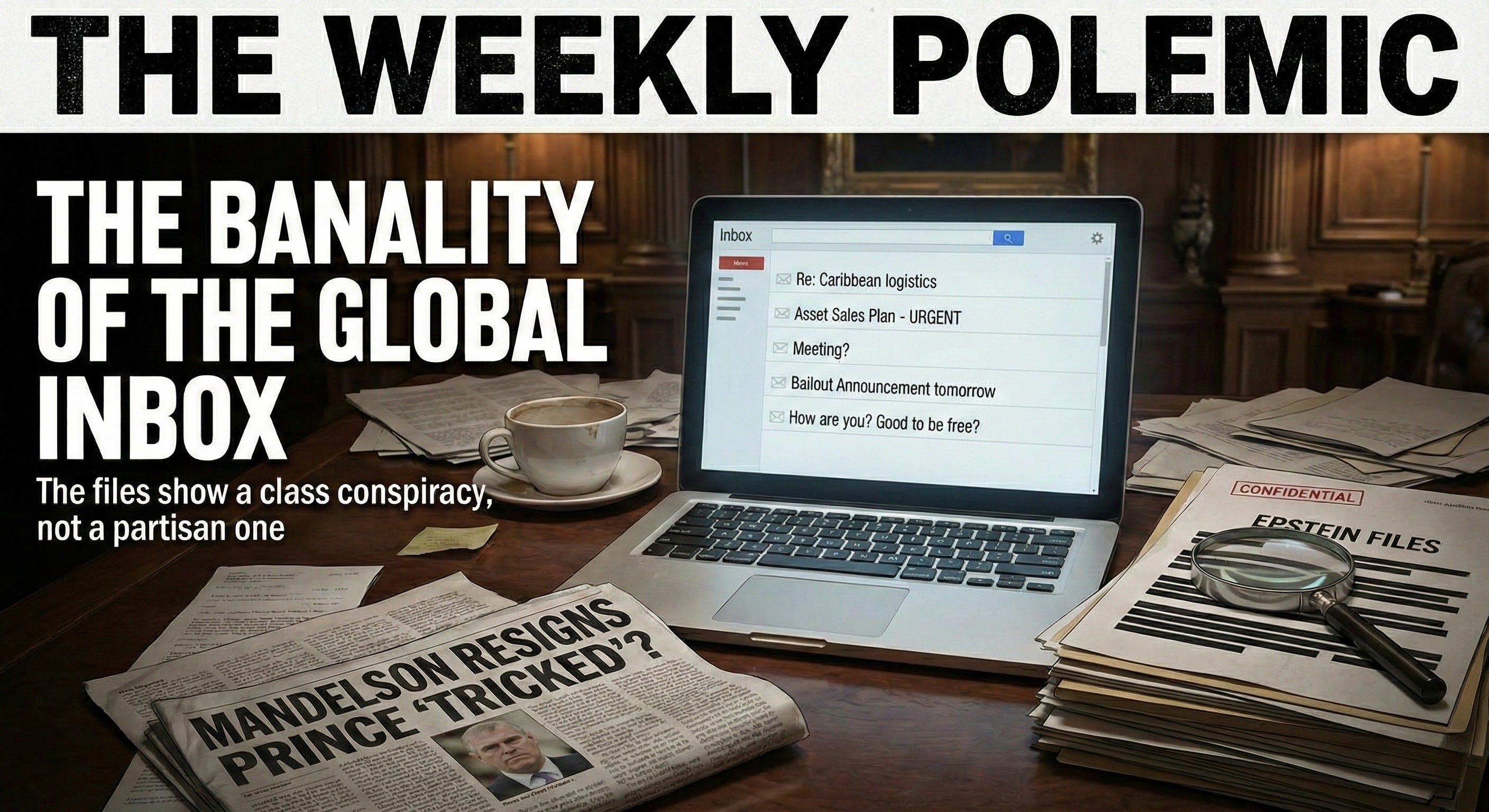
We’ve finally been handed the keys to the kingdom, or at least the digital version of it. With the release of 3.5 million Epstein Files and the subsequent humanising of that data through platforms like jmail.world, the murky fog of conspiracy has been replaced by something much more chilling: a searchable, everyday reality.
It turns out that while the so-called liberals were busy moralising about the sanctity of institutions, those very institutions were being treated as a private concierge service for a monster.
The Myth of the ‘Outsider’
There is a desperate, bipartisan scramble to paint this as a partisan scandal. The American left points at the ‘dog that hasn’t barked’ (Epstein’s cryptic 2011 code for Donald Trump); the right points at Bill and Hillary Clinton, who have finally agreed to testify before the House Oversight Committee only after the threat of a contempt of Congress vote.
But to look at this through a red or blue lens is to fall for the trap. The files don’t show a partisan conspiracy; they show a class conspiracy. When you scroll through the email inbox, you see the sheer normalcy of the rot. You see Noam Chomsky, the supposed conscience of the intellectual left, discussing Caribbean island logistics and fantasising about meetings. You see high-level tech moguls and Wall Street power brokers in the same digital orbit, entangled in discussions that make their public distancing look like a poorly rehearsed play.
The British Betrayal: Leaks and Misconduct
This rot is most toxic right here at home. For years, the British establishment treated the Epstein affair like a distant storm. This week, the dam broke and washed away the reputation of the ‘Prince of Darkness’ and the King’s brother alike.
Peter Mandelson has officially resigned from the House of Lords and is now under criminal investigation by the Met Police for misconduct in public office. The charge? That he wasn’t just lunching with a paedophile; he was allegedly leaking market-sensitive state secrets.
Emails show Mandelson forwarding internal briefing notes on the 2008 financial crash directly to Epstein. This included an asset sales plan (£20bn in value) intended for then Prime Minister, Gordon Brown, detailing which UK national assets were ‘saleable’ during the crisis. He even gave Epstein advance notice on a €500 billion bailout the day before it was announced. Perhaps most damning is Mandelson advising the head of JPMorgan to ‘mildly threaten’ the Chancellor to reverse a tax on bankers’ bonuses. I don’t know that we can consider this as merely socialising; it seems more like the use of a sex trafficker as a conduit for high-level economic espionage. Bizarre, to say the least.
The All Fours Prince
Then there is Andrew Mountbatten-Windsor. While the former Prince has spent years claiming he hardly knew the man, the latest files include photos of him in positions that make his honourable excuses look pathetic—specifically, photos of him on all fours, crouching over an unidentified woman in Epstein’s New York mansion.
But the emails are worse than the pictures. They show that in 2010, after Epstein’s conviction, Andrew was inviting him to private dinners at Buckingham Palace and asking him, ‘How are you? Good to be free?’ This isn’t a man who was ‘tricked’. This is a man who treated a child trafficker as a social peer and, potentially, as a procurement officer. The jury is out on the latter point, of course.
Transparency as a Weapon
The Department of Justice’s handling of this release has been a masterclass in incompetence. They accidentally exposed the faces of nearly 100 victims, forcing the site to be pulled down earlier this week, while carefully redacting the names of the powerful.
They claim they have nothing to hide, yet they have withheld 3 million pages. I suspect that they are trying to bury us in a haystack of unsearchable PDFs in the hope that we’ll grow tired of the search. Perhaps they haven’t recognised quite how hungry journalists as a whole are or how interested the general population is in the deceitful actions of the elites. I imagine, also, that they fear the more accessible, human interface of tools like Jmail because it removes the clinical distance and makes the evil visceral.
Closing Thoughts
The establishment’s greatest trick was making us believe that ‘free speech’ and ‘open discourse’ were dangerous because they might lead to ‘misinformation’. In reality, they feared discourse because it leads here, to a searchable inbox where their unpatriotic acts (as Gordon Brown now calls Mandelson’s leaks) are laid bare.
Shutting down discourse and hiding behind privacy redactions isn’t about protecting the vulnerable. It’s about protecting the client list—a list that we all suspect spans the entire political and corporate spectrum. If the government is allowed to redact the names of the powerful while exposing the victims, the system isn’t broken; it’s functioning exactly as intended. It’s a protection racket masquerading as a democracy.