
The ‘Farage Clause’: A Multibillion-Pound Pre-nup from the Relationship from Hell
Because nothing says 'sovereignty' like a multi-billion pound fine for having an original thought.

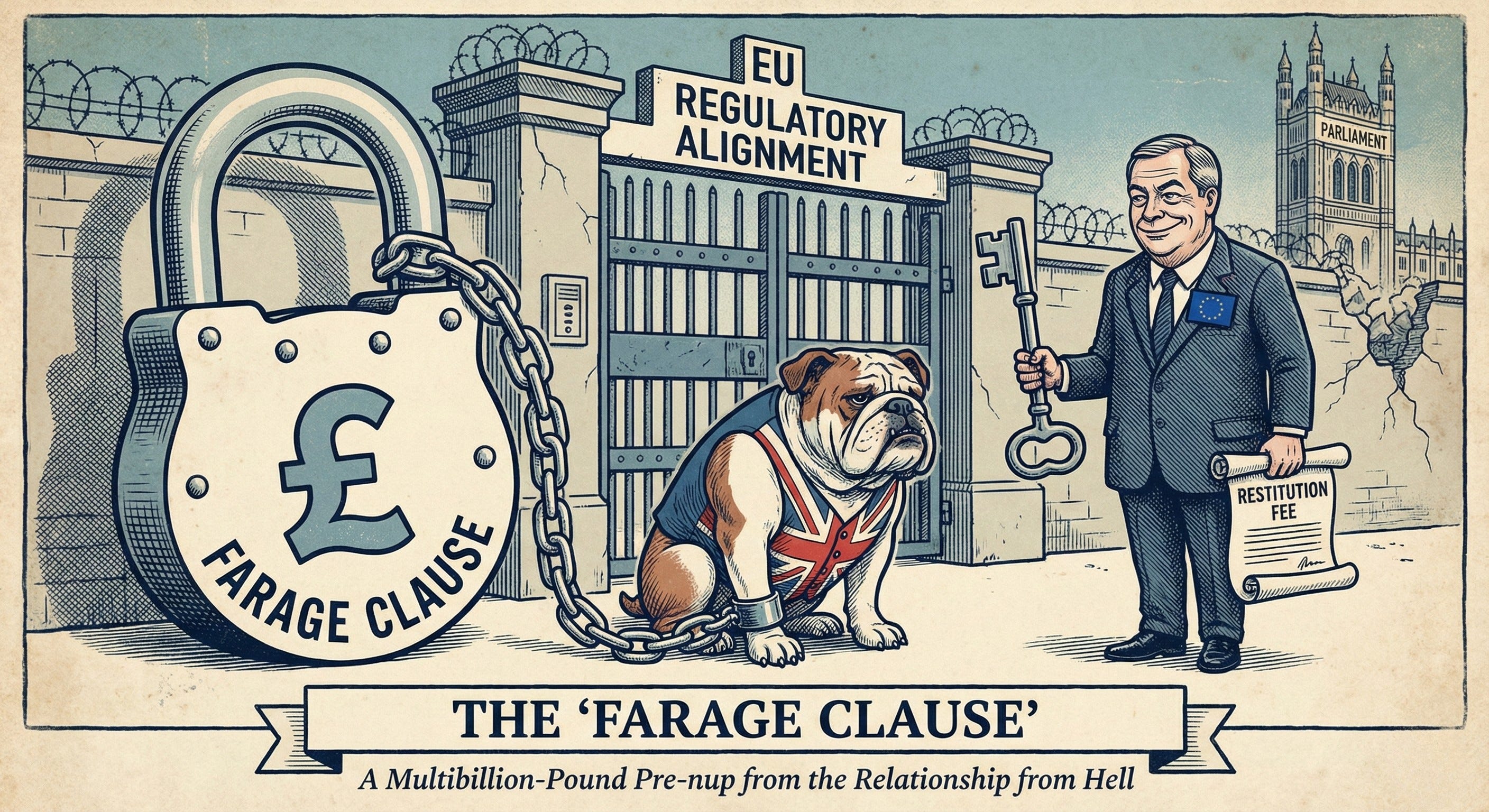
In the sanitised, fluorescent-lit corridors of Brussels, they’re calling it a cost-recovery mechanism. It sounds like something your accountant mentions right before telling you that you can’t afford a holiday this year. But in the dimly lit bars where the wine is expensive and the intent is honest, EU diplomats have a much better name for it: the ‘Farage Clause’.
The premise is as subtle as a brick through a window. As Keir Starmer busily knits the UK back into the EU’s ‘dynamic alignment’, specifically regarding veterinary and agrifoods standards, the EU is demanding a restitution fee.
If a future British government, perhaps one led by a certain cigar-chomping man in a Barbour jacket, or anyone else with a penchant for autonomy, dares to diverge from these standards, the UK gets hit with a multibillion-pound bill. This isn’t a trade tariff; it’s a financial ransom. It’s a ‘don’t-you-dare’ fee designed to make democracy so expensive that we simply can’t afford to exercise it.
Performing a Constitutional Lobotomy
For eight centuries, the British system has operated on a fairly sturdy principle: Parliamentary Sovereignty. As the legendary constitutional scholar A. V. Dicey famously articulated in his seminal work, An Introduction to the Study of the Law of the Constitution:
‘The principle of Parliamentary sovereignty means neither more nor less than this, namely, that Parliament... has, under the English constitution, the right to make or unmake any law whatever; and, further, that no person or body is recognised by the law of England as having a right to override or set aside the legislation of Parliament.’
By extension, the vital corollary is that no Parliament may bind its successor. It’s the legal equivalent of saying a nation is a living, breathing entity that has the right to change its mind, correct its mistakes, and occasionally wake up with a massive hangover and decide to go in a completely different direction.
By flirting with the Farage Clause, the Starmer administration isn’t just signing a trade deal; they’re performing a constitutional lobotomy. They are trying to create a locked-in state where the decisions of today are fossilised forever, protected from the unwashed voters of the future by a wall of debt. It’s the Whig Theory of History rewritten as a suicide note.
The Return of the Rump Parliament (With Better Suits)
History has a funny way of repeating itself, usually with worse hair. In 1648, the New Model Army didn’t technically abolish Parliament; they just purged everyone who didn’t share their ‘godly’ agenda, leaving behind the Rump Parliament. They kept the fancy building but hollowed out its soul.
What we’re seeing now is a Financial Rump Parliament. The managerial class isn’t banning the opposition; instead, they’re just rigging the deck so that an opposition victory becomes a purely symbolic gesture. If a future government receives a mandate to diverge from Brussels, they’ll find the Treasury has already been looted by a termination fee they never agreed to.
This is the philosophy of the managerial state, famously skewered by James Burnham. It’s the conviction that the world is far too complex for the passions of the plebs, and that real power should reside with the experts (the technocrats who operate in a vacuum, safely out of reach of a ballot box).
The Liberalism of the Grave
There is a delicious, dark irony in the way today’s so-called liberals are cheering this on. Classical liberalism—the stuff of Mill and Locke—was all about the marketplace of ideas and the necessity of dissent. Modern liberalism, however, has curdled into something far more restrictive.
We see it everywhere. When the establishment hears a voice it can’t answer, it deplatforms. When it encounters a democratic result it can’t accept, it ‘aligns’. They have replaced the right to be wrong with a duty to comply. By embedding the Farage Clause into our relationship with the Single Market, Starmer isn’t just seeking stability for trade. He’s seeking protection from the British people.
A Protection Racket, Not a Partnership
Let’s be clear: a relationship that requires a multi-billion-pound deterrent to keep you from leaving isn’t a partnership; it’s a protection racket. If the benefits of the Single Market were as self-evident as the Europhiles claim, they wouldn’t need a poison pill to keep us in the room.
The Farage Clause is a confession of weakness. It’s the sound of a dying political order frantically locking the windows before the sun comes up. If we allow this to pass, we aren’t just signing a deal; we are signing the death warrant of our own agency.
A democracy that isn’t allowed to change its mind isn’t a democracy at all. It’s a museum. And frankly, the gift shop is getting far too expensive.