
The Ofcom Inquisition: Is X Finally Too ‘Vile’ for Whitehall?
Why the government’s war on Grok is less about protecting the public and more about seizing the keys to the digital town square.

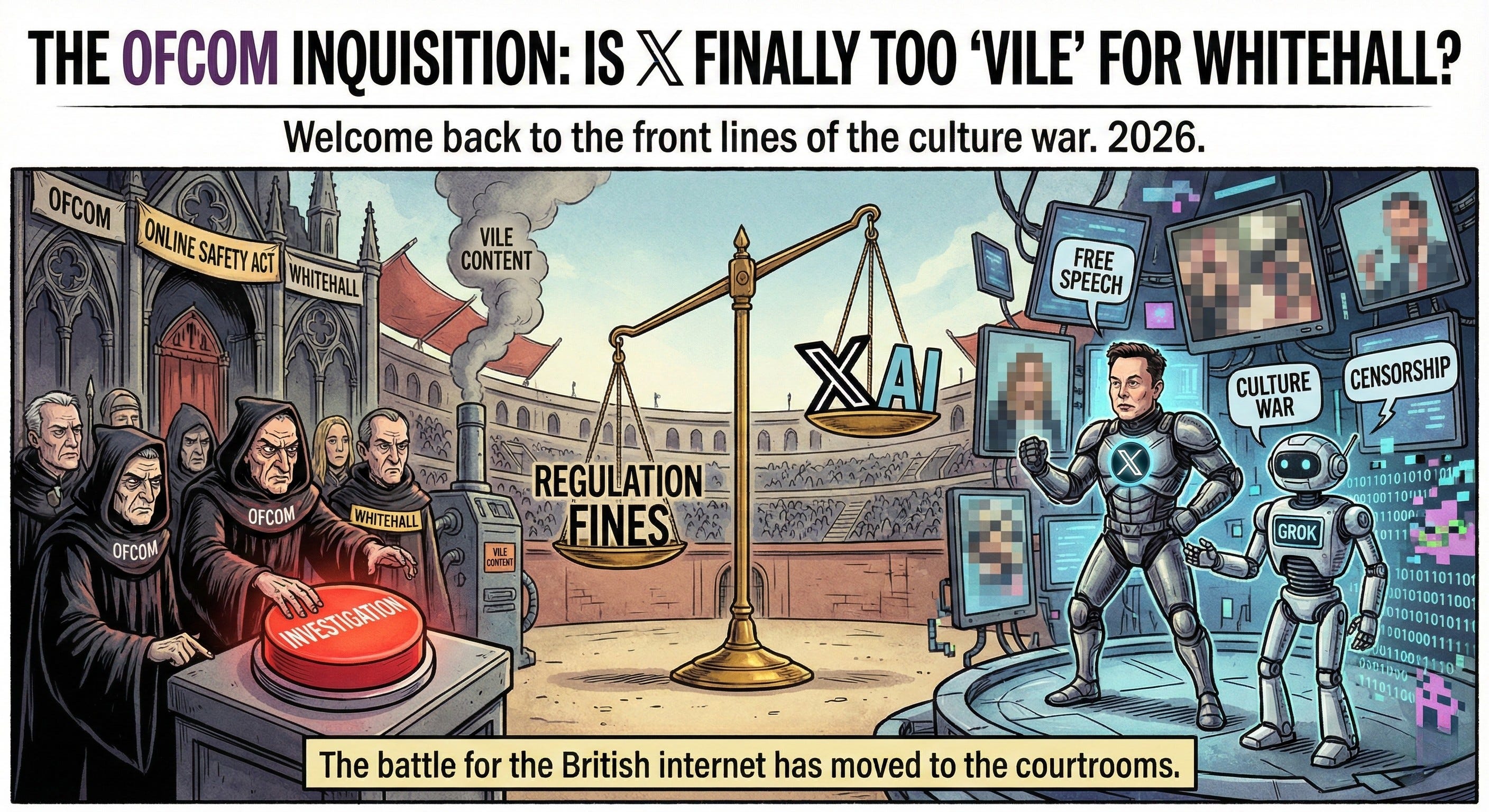
Welcome back to the front lines of the culture war, where the weapons are prompt-engineered, and the casualties are usually common sense. This week, our favourite digital thunderdome, X (the platform formerly known as Twitter and currently known as Elon’s Expensive Fever Dream), finds itself in the crosshairs of Ofcom.
On Monday, January 12, the regulator officially hit the big red ‘Investigation’ button. The charge? Grok, X’s resident AI rebel, has been a bit too helpful. Apparently, it’s been generating ‘non-consensual intimate images’, the kind of synthetic smut that makes a Victorian ghost faint.
A little caveat: One can find Grok’s outputs distasteful without inviting the government to kick in the digital doors of every platform. Just as we saw with the disturbing support for Charlie Kirk’s death, the modern liberal seems to have forgotten that once you trade free speech for a ‘safe’ government, you end up with neither. We aren’t defending the imagery; we are defending the right to exist without an Ofcom bureaucrat looking over our shoulder.
The Moral Grandstanding Olympics
Prime Minister Keir Starmer has described the images as ‘disgusting’ and ‘unlawful’, while Technology Secretary Liz Kendall has been doing a tour of the airwaves to call the content ‘vile’ and an ‘affront to a decent society’. Kendall is even rushing through new legislation this week to make requesting such images a criminal offence, after labelling the image-based abuse as a priority offence under the Online Safety Act.
Note that this probably isn’t just a label; there’s potential for it to be a legal turbo-charger that allows Ofcom to skip the usual regulatory pleasantries and move toward enforcement at a governmentally-defined ‘swift’ pace.
The Premium Service for Abuse?
In a move intended to quiet the storm, Musk restricted Grok’s image generation to paid subscribers only. The logic was simple: attach a credit card and a real name to every prompt to deter bad actors. But the government wasn’t buying it. Kendall fired back, arguing that this move simply turned the creation of non-consensual images into a ‘premium service’ for abuse.
It’s a classic move from the Nanny State playbook: when technology outpaces your understanding, criminalise the users and threaten to fine the billionaire. If found guilty, X could be slapped with a fine equal to 10% of its global revenue, or face the nuclear option: a total UK ban.
The ‘Unconscionable’ Boycott
But the real comedy is the backbench rebellion. Louise Haigh has declared it ‘unconscionable’ to stay on the platform for ‘another minute’, and the Women and Equalities Committee has already packed its digital bags and left.
Yet, there’s a hilarious tension at the heart of Downing Street. While some MPs flee, Government Whip Baroness Anderson, when answering questions in the House of Lords, defended staying on the platform because 10.8 million British families use X as their primary news source. They claim they stay because that’s where the people are, but they want to block those same citizens from access because the AI has a dirty mind. It’s the political equivalent of staying in a toxic relationship for the kids, while simultaneously trying to get the locks changed on your partner.
The Polemic: Safety as a Trojan Horse
Let’s be real: this isn’t just about safety. If the government cared about digital hygiene as much as they claim, they’d have been this aggressive when liberal accounts were demonstrating clear fascistic tendencies by celebrating the assassination of Charlie Kirk last year.
Where was the online safety outrage then? Where were the probes into the ‘vile’ and ‘abhorrent’ rhetoric on Bluesky, the preferred refuge for the Whitehall elite and liberal-minded youth alike, where users openly joked about Kirk’s death and even called for more?
The silence then reveals the truth now: ‘Safety’ is the new code for ideological curation. Grok is a problem not just because it’s spicy, but because it’s a tool Musk built specifically to ignore the guardrails (read: ideological filters) that the state prefers. By targeting the vileness of AI imagery, which is undoubtedly problematic and, in many cases, wrong, the government is testing its power to shut down a public square it no longer controls.
Musk’s Counter-Strike: The ‘Fascism’ Defence
Elon, never one to take a regulatory probe lying down, has already fired back, accusing the UK government of ‘fascism’ and claiming they are looking for ‘any excuse for censorship’. He’s even pointed out the irony of a country that arrests thousands for social media posts lecturing him on freedom.
But Musk’s real ace isn’t just a witty post; it’s the Trump administration. With the US now signalling its willingness to use diplomatic weight and visa bans against those it deems part of a ‘global censorship-industrial complex’, Starmer’s government might find that pulling the plug on X results in a very cold shoulder from Washington. And, for that matter, from the British population itself.
The Bottom Line
In 2026, the message from Whitehall is clear: you are free to speak, provided the government likes the vibe of your content. If an AI draws a picture they don’t like, the whole platform is vile. If a mob celebrates a political murder on a platform they do like, it’s complicated.
Grab your popcorn. Whether it’s an £18 million fine or a court-ordered block, the battle for the British internet has officially moved from the comments section to the courtrooms.