

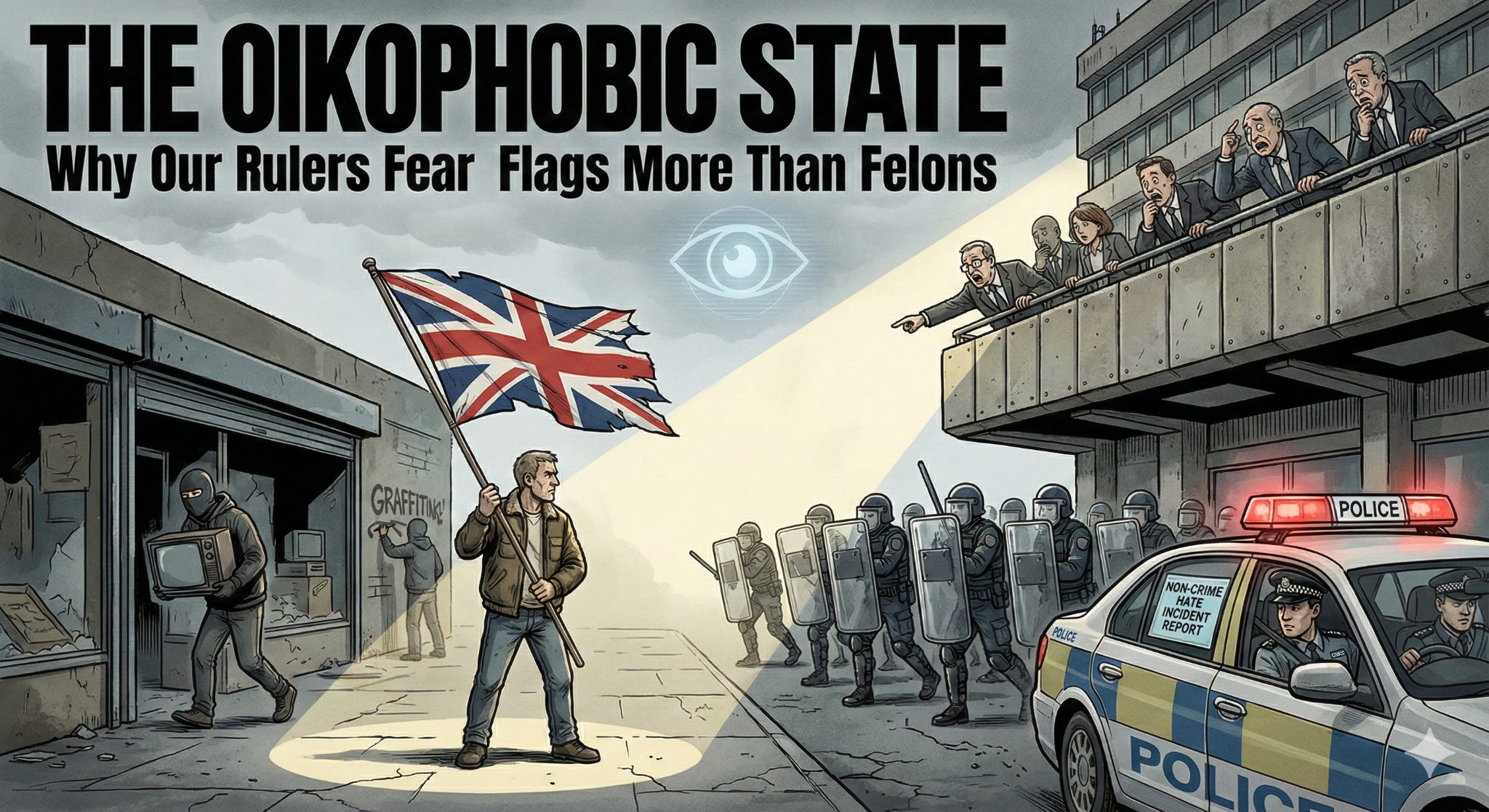
There is a distinct, bitter flavour to the madness currently gripping this archipelago. It is not merely the incompetence of a state that cannot keep the trains running or the borders secure; it is something more active, more malicious. We are witnessing a government that has effectively declared war on its own core demographic while rolling out the red carpet for chaos, crime, and foreign subversion.
If you want to understand the modern United Kingdom, you need only look at two recent, contrasting images. In one, a housing association or local council bureaucrat demands the removal of a Union Jack or St George’s Cross from a window, citing ‘intimidation’ or ‘offensive’ imagery. In the other, a gang of machete-wielding youths loots a high street store or brawls in broad daylight, while the police—too busy cataloguing ‘non-crime hate incidents’ on social media—are nowhere to be found.
This is not an accident. It is a system.
Welcome to Anarcho-Tyranny
The late political theorist Sam Francis coined a term for this precise stage of societal decay: Anarcho-Tyranny. It describes a state that is terrified of enforcing the law against actual criminals (the anarchy) but compensates by micromanaging the lives of law-abiding citizens with tyrannical ferocity.
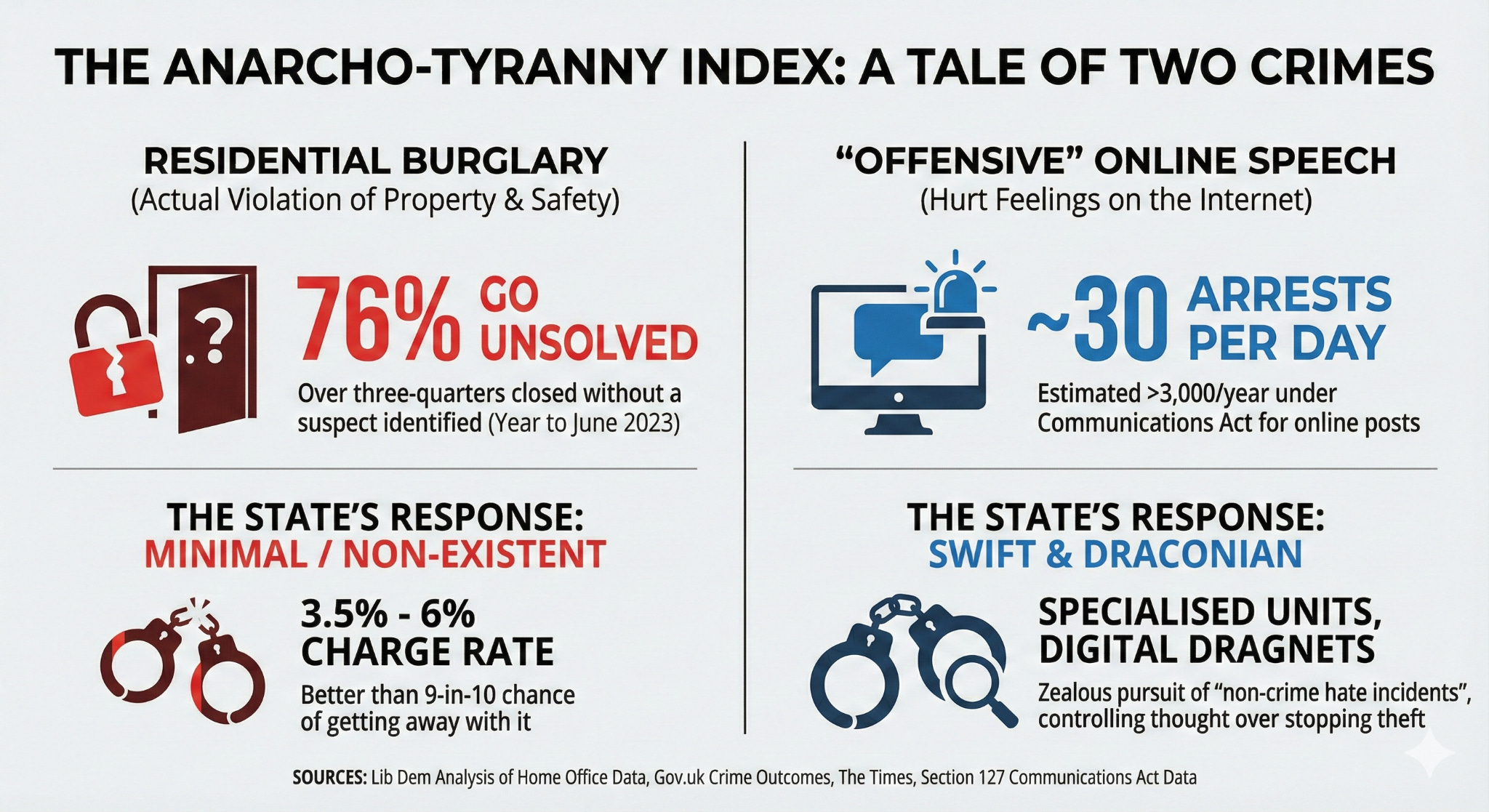
We see this played out in the statistics with grim hilarity. As recent investigations have highlighted, British police forces are now arresting roughly 30 people a day for ‘offensive’ online posts—policing challenging words with the zeal of the Stasi—while charge rates for burglary and shoplifting hover around the 5% mark.
However, a vital correction must be made here. People often get this bit wrong. This is not the fault of the constable on the beat. The average police officer or detective joined the force to catch thieves and protect the public, not to act as a glorified moderator for Facebook arguments. They are the foot soldiers of the Force, often appalled by the orders they receive, lions led by politicised bureaucrats. The rot does not start on the beat; it starts in the ‘Gold Command’ suites and the Home Office, where climbing the ladder now requires prioritising quotas and community cohesion over the hard, dangerous work of locking up villains. The police officer takes the public’s abuse, but it is the upper echelons who deserve the public’s contempt.
It is this politicised paralysis at the top that produces the inverted morality we see in practice. Because the leadership is obsessed with optics rather than order, we are left with a justice system that functions in reverse.
Unfortunately, though, if you steal a car, you are a victim of socio-economic circumstance. If you tweet that you don’t like your car being stolen, you are an agitator. (Sadly, that’s not too much of an exaggeration.) The state has retreated from its primary duty (protection) and advanced into a domain where it has no business (the soul).
The Criminalisation of the Native
The most visceral manifestation of this sickness is the war on the national flag. In a healthy society, the flag is a neutral, unifying totem. In ours, it has been re-coded by the managerial elite as a symbol of ‘far-right’ aggression and historical abuses.
We have reached a point of inversion where the native population flying their own flag is treated as a provocation, yet the flags of foreign nations, political movements, or ideological sub-groups are celebrated as vibrant and inclusive. To the Oikophobic (home-hating) mind of the modern progressive, the St George’s Cross (even the various Union flags) represents a threatening, unwashed past, a reminder of a people they would like to be silent.
I’d go as far as saying that we are witnessing the rise of the sectarian veto. Police chiefs are now effectively negotiating with community leaders, often representing foreign grievances and international conflicts, to decide what laws will be enforced and where. If a particular foreign-influenced faction threatens disorder, the police retreat. If a native grandmother protests the loss of her community, she is arrested. In that scenario, the law is no longer applied equally; it is applied inversely to the threat of violence.
This is why you see swift, brutal policing of ‘patriotic’ protests, yet a soft-touch, ‘community engagement’ approach to sectarian mobs screaming for blood on our streets. The state fears the former because it challenges their legitimacy; it tolerates the latter because it fears their violence.
A History of Self-Sabotage
This phenomenon, while acute, is not entirely novel. History is littered with regimes that turned on their own foundations when they became too bloated, corrupt, or beholden to external interests. To understand where we are going, we must look at who has been here before.
1. The Athenian Implosion: Democracy Eating Itself
We often look to Ancient Athens as the cradle of democracy, but we forget how it died. During the Peloponnesian War, the Athenian state was consumed by stasis—civil strife and factionalism. The demos became easily swayed by demagogues who turned the population against its own leaders.
The most shameful moment came after the Battle of Arginusae (406 BC). The Athenian navy won a stunning victory but, due to a storm, failed to rescue some survivors. Instead of celebrating the win, the Athenian assembly, whipped up by political opportunists, put their own victorious generals on trial and executed them. They decapitated their own military leadership to satisfy a momentary mob hysteria. By turning on their own defenders, they guaranteed their eventual defeat by Sparta. A society that wars with its own guardians, as we are doing today, is a society preparing for its own funeral.
2. The Roman Suicide: The Constitutio Antoniniana
In 212 AD, the Emperor Caracalla issued the Constitutio Antoniniana, a decree that granted Roman citizenship to effectively every free man within the empire’s borders. Modern progressives might view this as a triumph of inclusivity, but the contemporary historian Cassius Dio saw it for what it was: a cynical tax raid.
By diluting citizenship to the point of meaninglessness, the distinction between ‘Roman’ and ‘Barbarian’ evaporated. The state stopped being a guardian of a specific people and culture and became merely a tax-extraction machine. The result? The native Romans were taxed and regulated into destitution to pay for a bloated military and bureaucracy, while the army itself became filled with mercenaries who had no loyalty to the Roman ethos. The state cracked down on its own tax-paying base with ruthless efficiency, but left its borders porous and its identity undefined. We know how that story ended: with the gates opening from the inside.
3. The Habsburg Paralysis
By the late 19th and early 20th centuries, the Austro-Hungarian Empire had become the ultimate warning against the management of grievances. The state became so obsessed with balancing the competing claims of its various ethnic minorities—Czechs, Croats, Hungarians, Poles—that it forgot its core Germanic identity.
The bureaucracy was paralysed by what we would today call ‘identity politics’. In the 1890s, the Badeni Crisis over language laws led to fistfights in parliament and total legislative gridlock. The police and civil service spent all their energy policing who could speak what language where, and which flags could be flown in which districts. Meanwhile, the actual structural integrity of the empire rotted away. They were so busy managing diversity that they failed to notice they were sliding into a world war that would dissolve them entirely. The state died of introspection.
4. The Soviet Inversion
Perhaps the most chilling parallel is the Soviet satellite states of the mid-20th century. In communist Poland or Hungary, the flying of the national flag or the singing of traditional anthems was frequently policed as ‘bourgeois nationalism’ or ‘counter-revolutionary’.
The state’s loyalty was not to the nation, but to an Internationalist ideology (and its masters in Moscow). The police existed not to stop street crime, which was rampant and often ignored by authorities who manipulated the stats, but to crush any sign of independent national consciousness. If you were a thief, you were a ‘social deviant’ who could be re-educated. If you were a patriot, you were an enemy of the state. The regime feared the flag more than the felon because the flag represented a rival source of legitimacy: the love of one’s own home.
The Cracks in the Citadel
However, to despair is to grant these cultural vandals a victory they have not earned. If history teaches us the dangers of Anarcho-Tyranny, it also teaches us its fragility. Regimes that declare war on reality—and on their own populations—eventually run out of road.
Crucially, the consensus of the managerial class is fracturing. We are no longer shouting into a void. For the first time in decades, there is a growing phalanx of politicians—across the House and outside the traditional machinery—who are articulating exactly what the average working-class person has known for years. They recognise that a nation is not a hotel, that citizenship is not a coupon scheme, and that the first duty of the state is to its own.
These representatives are breaking the omertà of the elite. They are pointing out that the emperor has no clothes, and certainly no right to ban our flags. The alignment between these dissident voices in Westminster and the silent majority in the shires and estates is the single greatest threat to the status quo. The Oikophobes are terrified not because they are strong, but because they know their ideology cannot survive the ballot box once the people are offered a genuine alternative.
The Restoration
The trajectory of Athens, Rome, or the Soviet Satellite states is a warning, not a prophecy. We are not doomed to follow them into the abyss, provided we heed the lesson they ignored: a state cannot survive without the consent and affection of its people.
The madness we see—the policing of flags and opinions, the ignoring of crime—is the fever dream of a dying political epoch. It is the lash of a system that knows it has lost the moral argument.
All is not lost. The instinct for home, for order, and for identity is written into the human heart deeper than any hate-crime legislation. We have the history, we have the numbers, and now, finally, we are finding the political voice to demand a restoration. The flag will fly again, not as an act of rebellion, but as the standard of a restored and sane nation.
P.S. Here’s what you can do:
Fly the Flag: It is not illegal. It is necessary. Normalise the sight of it. (Just like in every other nation.)
Support the Dissidents: Back the politicians and writers breaking the consensus.
Share this Article: The first step to ending the madness is naming it.