
The Panopticon Paused: Whitehall Blinks on the Digital ID Mandate
We woke up to the rarest of things: a government in retreat. But while the mandatory ‘Right to Work’ ID has been scrapped, the infrastructure for a database state remains.

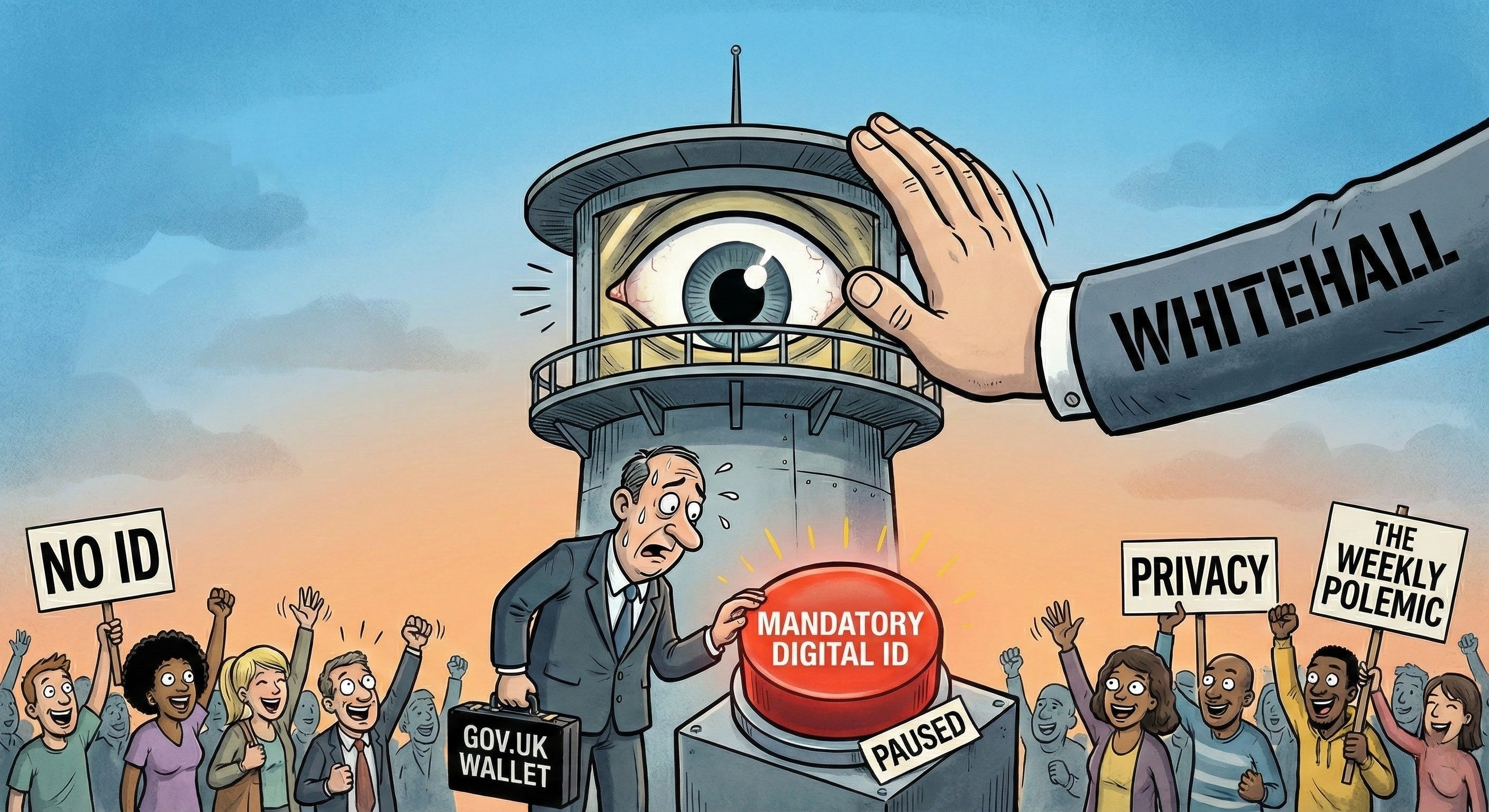
It is a rare and beautiful thing to wake up to the sound of a government hitting the brakes.
Usually, the news in this country is a relentless march of ‘modernisation’, a euphemism for the slow, systematic dismantling of privacy in favour of administrative convenience. But today, the air feels slightly clearer. Following months of nationwide fury and an international outcry that made the UK look more like a digital testing ground for autocracy than the cradle of common law, the Government has performed a spectacular, screeching U-turn on its Digital ID mandate.
The ‘Right to Work’ wall has crumbled.
The Backtrack
Just months ago, in September 2025, Prime Minister Keir Starmer was categorical. Addressing the Global Progress Action Summit, he declared: ‘You will not be able to work in the United Kingdom if you do not have digital ID.’ It was a ‘papers, please’ moment for the 21st century, a move to tether the right to earn a living to a government-controlled digital token.
The public response was a roar. A parliamentary petition against the scheme amassed nearly three million signatures, making it one of the largest in British history.
Faced with this tidal wave of opposition, the government blinked. Late Tuesday night, January 13, officials began the frantic process of rowing back. The mandatory requirement for a specific digital ID to prove the right to work has been dropped. Instead, they have pivoted to the language of ‘flexibility’, allowing other forms of documentation to remain valid. Perhaps, ideological flexitarianism is the new vogue?
A government spokesperson, desperate to frame the humiliation as a planned evolution, stated:
‘We are committed to mandatory digital right-to-work checks... We have always been clear that details on the digital ID scheme will be set out following a full public consultation. Digital ID will make everyday life easier, but we remain focused on inclusivity.’
Translated from the original Bureaucrat: The polling was terminal, and we realised we couldn’t barcode the entire workforce without a riot.
The Semantic Shuffle
We should savour this victory. Silkie Carlo, director of Big Brother Watch, which led the charge against the BritCard proposals, correctly identified the stakes:
‘We welcome Starmer’s reported U-turn on making intrusive, expensive and unnecessary digital IDs mandatory. This is a huge success for Big Brother Watch and the millions of Brits who signed petitions to make this happen.
The case for the government now dropping digital IDs entirely is overwhelming. Taxpayers should not be footing a £1.8bn bill for a digital ID scheme that is frankly pointless.
The proposal to make right to work checks digital could raise similar cybersecurity, fraud and privacy risks that digital IDs carry. The devil will be in the detail but this whole digital ID debacle smacks of incompetence.’
However, we probably shouldn’t mistake a tactical withdrawal for a change of heart. The technocrats haven’t discovered a sudden love for civil liberties; they have simply realised that the ‘mandatory’ label was political kryptonite.
The strategy will likely shift from coercion to convenience creep. By keeping the digital ID voluntary, they can still build the infrastructure. They will make life without it a Kafkaesque nightmare of delays and legacy paperwork. They will probably go as far as to offer fast lanes for the digitally tagged and friction for the free. They want to make the ID voluntary in the same way that having a bank account is voluntary: yes, it is technically optional, but practically essential for survival in modern society.
A Pattern of Spinelessness?
Opposition parties have been quick to pounce. Shadow Cabinet Office minister Mike Wood described it as a ‘humiliating U-turn’, while Kemi Badenoch noted that the Prime Minister is ‘turning the corner straight into another U-turn.’
They aren’t wrong, but their focus is on political optics. Our focus must remain on the surveillance architecture.
The government source that spoke to The Times let the cat out of the bag, admitting that the mandatory element was ‘stopping conversation about what digital IDs could be used for generally.’ They want us to stop arguing about the principle so they can get on with the installation.
The Price of Liberty
Today, we celebrate. We proved that the government still fears a united citizenry. We proved that the British people still have a visceral, healthy disgust for being numbered and tracked by the state.
But tomorrow, we will watch the consultation. We watch the ‘voluntary’ rollout. We watch the GOV.UK Wallet like a hawk.
The panopticon has been paused, not dismantled. If we stop speaking out, they will simply turn the volume down and continue building the walls in silence.