

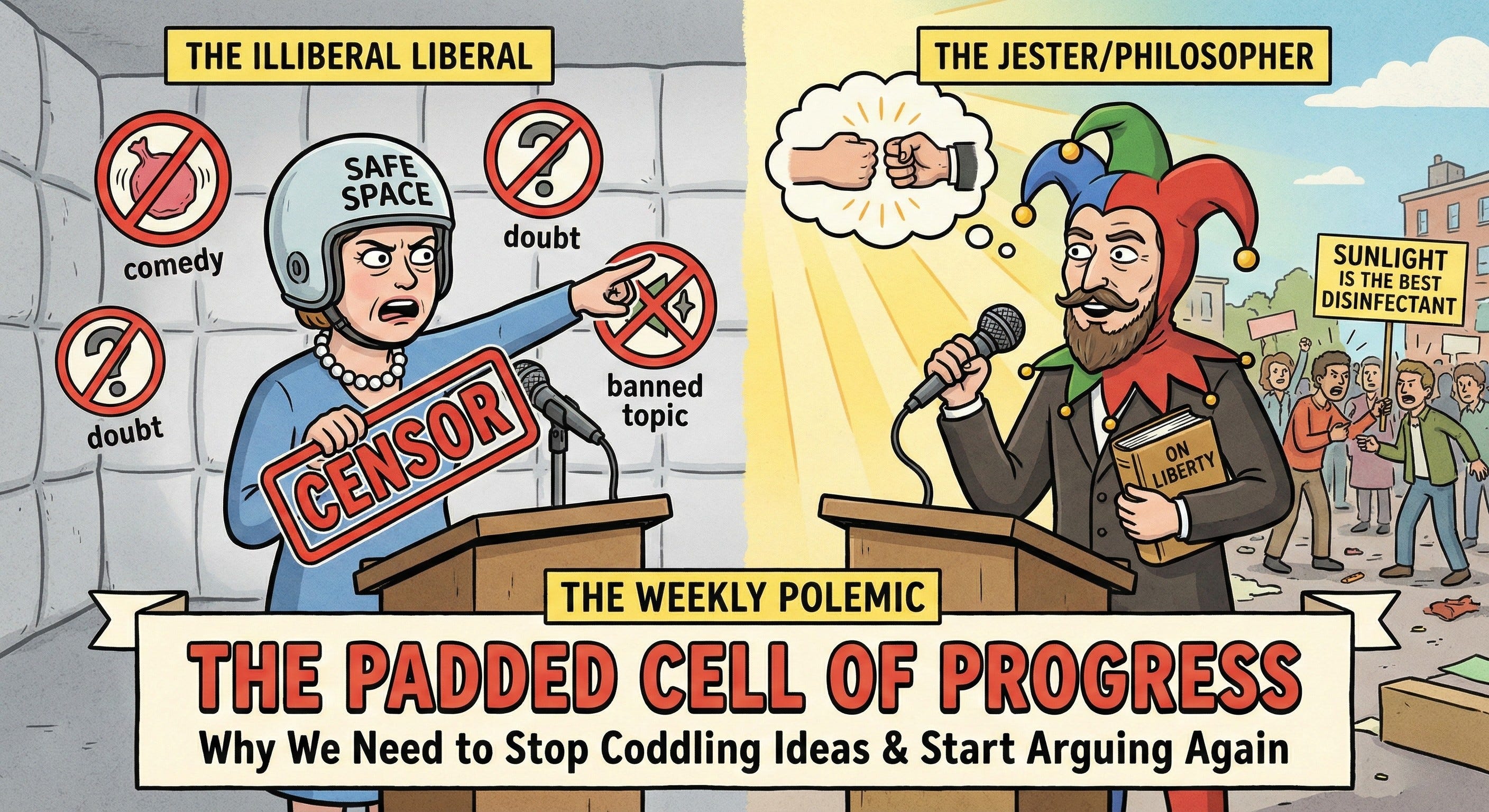
We have reached a bizarre point in our cultural evolution where a sharp opinion is treated like a biohazard. We’ve traded the public square for a padded cell, convinced that if we simply stop people from saying ‘the wrong thing’, the world will magically become a utopia. It won’t. It’ll just become a very quiet, very boring, and eventually, very dangerous place.
The self-appointed moral guardians of our age, often those who shout the loudest about being ‘liberal’, have developed a curious, almost fascistic allergy to disagreement. They view a robust debate not as a tool for discovery, but as a threat to be managed. They’ve forgotten that the moment you decide a topic is ‘off-limits’, you haven’t won the argument; you’ve just admitted you’re too fragile to have it.
If you want to see how healthy a society is, look at its comedians. Historically, the jester was the only one allowed to tell the King he was a prat without losing his head. Comedy is our collective pressure valve. It allows us to process the horrific, the taboo, and the downright absurd through the lens of irony.
When we start de-platforming comics for ‘harmful’ jokes, we aren’t protecting anyone. We are dismantling the very mechanism that allows us to cope with reality. If a joke is ‘offensive’, don’t laugh. It’s that simple. But the rush to shut down the microphone reveals a terrifying insecurity: the fear that if people are allowed to laugh at the ‘wrong’ things, the entire ideological house of cards will come tumbling down. We’ve replaced the ‘heckler’s veto’ with the ‘bureaucrat’s ban’, and in doing so, we’ve lost the ability to see ourselves as the flawed, ridiculous creatures we actually are.
‘If we don’t believe in freedom of expression for people we despise, we don’t believe in it at all.’ — Noam Chomsky (an irony likely lost on those currently busy cancelling people in his name).
Philosophically, we’re backsliding. John Stuart Mill argued in On Liberty that even if an entire society holds one opinion and only one person holds the contrary, society has no more right to silence that person than he would have to silence society.
His reasoning wasn’t just about being nice; it was practical:
The Unwelcome Opinion Might Be True: If we suppress it, we lose the chance to swap error for truth.
The Unwelcome Opinion Might Be False: By debating it, we gain a ‘clearer perception and livelier impression of truth’ by seeing it collide with error.
Mill identifies a specific brand of arrogance in the censor: the assumption of infallibility. When you shut down a debate because you are ‘certain’ you are right, you are claiming that your current knowledge is the peak of human history and can never be corrected. He was particularly obsessed with the idea of ‘Living Truth’ versus ‘Dead Dogma’. He argued that even if you hold the absolute truth, if you never have to defend it against a hostile opponent, that truth becomes a ‘dead’ thing. It becomes a script you recite rather than a principle you understand. By insulating our ideas from the ‘unwelcome’ topics, we’ve stopped being thinkers and started being parrots.
Sidebar: A Guide to Modern Heresy
The Sin: Suggesting that a joke is just a joke or that a ‘settled’ topic deserves another look.
The Penance: Three days of public flagellation on social media and a mandatory 40-page apology written in HR-approved prose.
The Reality: We have reached a state of peak absurdity where the people most concerned with ‘safety’ are the ones creating the most hostile environments for actual thought.
There is a staggering lack of self-awareness in the ‘progressive’ push to censor. To claim you are fighting for a better world by employing the tactics of a 1950s authoritarian is, frankly, laughable. True liberalism isn’t about creating a ‘safe space’ where no one’s feelings get hurt; it’s about creating a ‘brave space’ where every idea is interrogated.
Shutting down discourse is the ultimate act of intellectual cowardice. It assumes the public is too stupid to decide for themselves. It’s a paternalistic, elitist mindset that treats the citizenry like children who might be ‘corrupted’ by a spicy tweet or a controversial lecture.
Facing the Furies: The Steelman Challenge
The usual suspects will claim this call for open debate is a dog whistle for hate. Let’s address those tired tropes head-on:
The Pushback
‘But some ideas are actively harmful/incite violence.’
The Counter
Distinguish between incitement (illegal) and offence (legal). Mill’s ‘Harm Principle’ only limits speech when it causes direct, physical harm, not ‘harm’ to someone’s feelings.
The Pushback
‘Giving a platform to bigots legitimises them.’
The Counter
Sunlight is the best disinfectant. If an idea is genuinely bigoted, the best way to destroy it is to let it be heard and then publicly dismantled. Hiding it only lets it fester.
The Pushback
‘Freedom of speech isn’t freedom from consequences.’
The Counter
True, but if the ‘consequence’ for a dissenting thought is losing your livelihood, you don’t have a free society; you have a soft-launch totalitarianism.
The Pushback
‘We don’t have time to debate settled science/morals.’
The Counter
Nothing is ever ‘settled’ forever. The moment we stop questioning the foundations, the foundations start to rot. Debate is the maintenance work of a civilisation.
We don’t need less debate; we need more of it. We need the friction. Friction is what creates light, and god knows we could use some of that right now. We need to stop clutching our pearls every time someone says something that challenges our worldview and instead, do something radical: listen, and then tell them exactly why they’re wrong.
If your ideas can’t survive a conversation with a comedian or a contrarian, they probably weren’t very good ideas to begin with. If we continue to outsource our thinking to the censors, we shouldn’t be surprised when we wake up with nothing left to say. True progress requires the messiness of the forum, not the sterility of the lab. Let’s stop being afraid of words and start being afraid of the silence that follows when they’re gone.