
Your Phone is Now a State Informant
Privacy isn't a right anymore. It’s a luxury the state can no longer afford you. Meet the algorithm reading your mind before you press send.

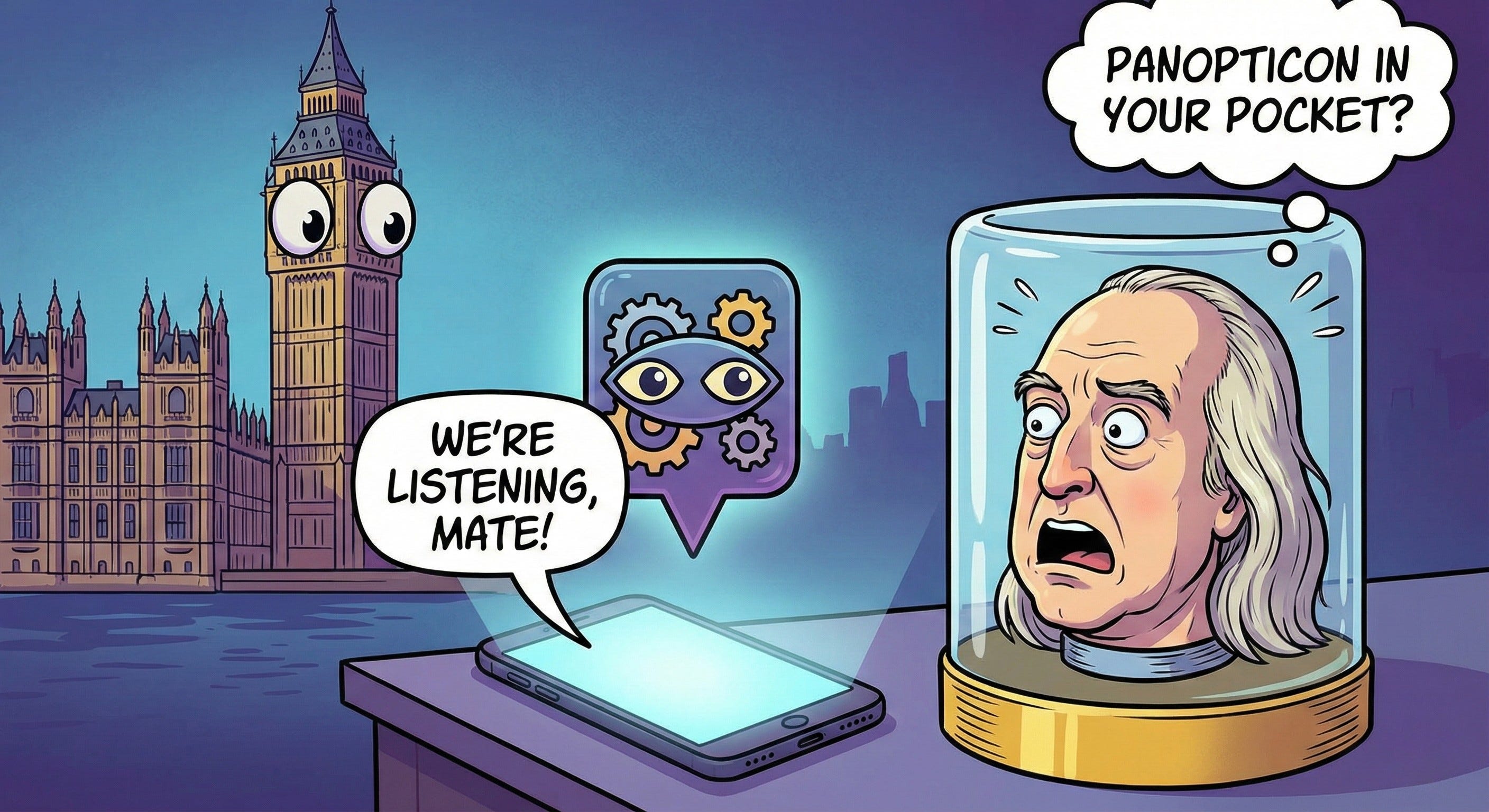
Pick up your smartphone. Look at it. For the last decade, we have laboured under the comforting illusion that this device, the repository of our deepest secrets, our whispered conversations, and our highly questionable 03:00 AM Google searches, was truly ours. We believed that when we pressed ‘send’ on an encrypted message, the digital envelope remained sealed until it reached its intended recipient.
That illusion is officially shattered.
The United Kingdom is looking to finalise the infrastructure for the most pervasive state surveillance apparatus in Western democracy. Under the innocuous banner of the Online Safety Act, specifically the draconian powers granted by Section 121, the government has effectively deputised your own personal device as a spy for the state. The era of ‘private by default’ is over; the era of ‘monitored by default’ is upon us. And the kicker? We’re still going to be paying £60 a month for the privilege of being bugged. (Well, if you have a contract, anyway.)
For years, politicians bemoaned ‘end-to-end encryption’ as a dark alley where criminals hide. Having lost the frontal assault on encryption, the state has opted for a more insidious flanking manoeuvre: client-side scanning.
As detailed in a recent analysis by CYBER WAFFLE, the government no longer needs to break encryption during transit. Instead, Section 121 empowers Ofcom to mandate that messaging platforms—WhatsApp, Signal, iMessage—install software that scans your communications on your device before they are encrypted.
Imagine you’re writing a heartfelt, private letter in your study. The government isn’t trying to steam open the envelope at the post office anymore. Instead, they’ve sent a bored civil servant named Keith from Slough to sit on your sofa and read over your shoulder while you write. If Keith doesn’t like your adjectives, he flags it. The fact that you seal the envelope afterwards is a hilarious formality. Your phone is no longer your advocate; it’s a double agent with a data plan.
Philosophically, we are witnessing the final realisation of Jeremy Bentham’s Panopticon. Bentham envisioned a prison where a single guard could observe all inmates without them knowing if they were being watched at any given moment. The result? The prisoners began to police themselves.
By placing a scanner on every phone, the UK government isn’t just looking for ‘bad’ content; they are fundamentally altering the human psyche. When you know an algorithm is reading over your shoulder, you stop being a free agent. You become a subject in a state of permanent visibility.
As Michel Foucault warned, ‘visibility is a trap.’ Poor Jeremy Bentham’s preserved head is currently sitting in a jar at UCL; if he knew his architectural dream was being used to flag ‘subversive’ memes about the Prime Minister’s haircut, he’d probably try to roll out of the building. Make no bones about it… This isn’t just about security. It is about the psychological subjugation of a population that no longer has a space to think or mock outside the state’s gaze.
The justification for this intrusion is, as always, the moral high ground. It is unassailable on the surface: the prevention of terrorism and the scourge of child sexual abuse material (CSAM). It’s the classic Trojan horse. To argue against the intent is political suicide, which is precisely how, I imagine, they want it.
But let’s be real: for the state to find the ‘bad’ stuff, they have to sift through the ‘everything’ stuff. That means an Ofcom-approved algorithm is currently being trained to navigate the absolute wasteland of the British psyche:
4,000 near-identical photos of your cat.
Aggressive WhatsApp debates about whose turn it is to take the bins out.
The 47th draft of a strongly worded email you’ll never send.
By invading the private digital sphere, the state is effectively poisoning the well of public discourse. We are creating a monitoring-ready state where the presumption of innocence is replaced by a technological presumption of guilt, requiring constant digital vindication.
It is a grim irony that those who scream the loudest about protecting democracy are the first to applaud when the state builds the machinery to dismantle it. They forget that a cage built for your enemy today—the ‘dangerous’ speaker, the ‘fringe’ activist—is easily repurposed for you tomorrow.
This brings us to the warning of Hannah Arendt, who famously argued that the private realm is the essential nursery of the public realm. If you do not have a private space to develop ideas, to dissent, and to be messy, you cannot truly participate in a democracy. When the nursery is bugged, the public square becomes a theatre of performance rather than a place of truth.
Also, jot this down: we are a part of the first generation in human history to celebrate our freedom while carrying a government-mandated snitch in our pockets. We can’t claim to be pioneers of idiocy, but we might well be plastered on a digitalised poster in future centuries, advertising it.
This is not a dystopian future scenario. It is not, as much as we might hope, a Black Mirror script. It is imminent policy. Lord Hanson of Flint has confirmed the timeline: Ofcom is on track to finalise the technical standards for this scanning technology by April 2026.
We have seen this movie before. The UK government previously attempted to strong-arm tech giants like Apple into breaking their own security protocols. While trillion-dollar corporations have the resources to fight these orders, how many smaller platforms have already silently capitulated?
The UK is standing on a precipice. We are trading the foundational human right to a private life for a security theatre that treats every citizen as a pre-crime suspect. As it currently stands, when the history of digital liberty is written, April 2026 may well be marked as the date the United Kingdom decided that privacy was a luxury—and freedom a mere permission—it could no longer afford.
The Final Word: A Glossary of Government Newspeak
The Government Says: ‘Proactive detection using accredited technology.’
The reality: It’s spying. If a third party, be it a human or a state-mandated algorithm, reads your mail before you’ve even licked the envelope, the privacy of the communication is dead.
The Government says: ‘Ensuring user safety through Section 121.’
The reality: It’s a digital stop-and-search. It’s the assumption that every citizen is carrying something illicit until their phone proves otherwise to a server in Whitehall.
The Government Says: ‘Protecting the children.’
The reality:It’s a moral Trojan horse. We are being asked to trade the very concept of a private life for a security theatre that wouldn’t have actually stopped the systemic failures we’ve seen in the past.
If you knew Keith from Slough was reading your texts today, what’s the first thing you’d tell him? Let’s keep the discourse messy and private while we still can.
Sound off below, friends.